22 February 2011

Getting Around While Travelling


Of great concern to you as a would-be traveler might be how to get around a given locale once you have arrived at your destination. You can rent a car in Europe if you like. Just keep in mind that in order to drive in Europe you need an International Driving Permit, which you can obtain from your local AAA or National Auto Club office. These are the only two agencies in the United States officially authorized to issue IDPs, so beware any others offering to give you one. The US Department of State's website has a page that's chock full of information on driving in far-off lands. Then, of course, you'd need to book you're rental in your destination; the rental agency names will look familiar to anyone who's rented a car in the States. It is also worth noting that the VAST majority of private cars are equipped with manual transmissions; while this may not be the case with rental fleets, it's probably not a bad idea to have some experience on a stick shift.

While I have at times thought that having a car would be of benefit, these have all come as I was out in the countryside. Driving in central Barcelona looks to my American eyes like an unnerving proposition and there is a distinct dearth of available parking in a city as densely populated as the larger ones you'll find in Europe. There are a ton of options that you simply do not find in the US (or at least in the great majority of the country). On the local scale there are Metro systems in Barcelona, Madrid, Bilbao, Palma de Mallorca, Seville and Valencia. You might even be treated to a live performance and dancing!
If you're not staying in one of those cities, you can check out the Cercanias commuter train service provided by the kingdom's national railway, RENFE. These commuter rail networks serve Asturias, Cadiz, Malaga, Murcia/Alicante, Santander, San Sebastian, and Zaragoza. The Cercanias sites are in Spanish, but you should be able to use a translator program to take care of that. Smaller cities such as Girona, Granada, Los Barrios and Algeciras have readily accessible bus systems to ferry you about their environs. Others, such as the town of Jaen, with a population of 120,000, are also building tram system.

RENFE will also ferry you between cities. Offering nearly comprehensive coverage of Spanish territory, the railway can almost certainly get you wherever it is you'd like to go. One of MY favorite aspects of the service is the price; a single-passenger one-way ticket from Barcelona to Girona will set you back as little as 6.75 euros depending upon the type of service you use. The day trips are naturally the cheapest. AVE high-speed trains are naturally the most expensive, but if you're in a hurry and don't like the idea of flying, they're a great alternative.

Speaking of flying, Europe has a number of discount carriers to choose from as well as some great websites to help you find cheap fares. Again, these will get you where you're going in most cases, but be sure to read the fine print. Unsuspecting travelers can incur fees for using credit cards to purchase flights, failing to check-in online, failing to check-in on time, checking bags, checking heavy bags, looking cross-eyed at the flight attendants or complaining about the fees while in an airline queue. It can be maddening and the misses and I have had a bad experience with one of the airlines in question whose name begins with an "R" and ends with a "Yanair."

Last but certainly not least, there are always buses, and I mean that quite literally. You can take buses on the city, county, provincial, regional and national levels. They're going to be slower, obviously, but if you're in no great hurry they can be a nice way to see some landscape at a slower pace. And buses go from just about everywhere to just about everywhere else, so if your destination is a little more out-of-the-way such as Los Barrios or Gibraltar, it's still not inaccessible.

I would be remiss at this point if I failed to mention that Barcelona has its own bus system, as do all of the major cities in Spain. If you are feeling adventurous and are not easily intimidated, the bus maybe the way for you to travel. There are myriad lines snaking across the city; almost no corner lies beyond the purview of the bus systems. These range from buses that have small circulations through a few neighborhoods to buses that travel to the furthest reaches of greater Barcelona. A good deal of redundancy is built into the network as well to prevent buses being overcrowded and keep wait times during peak travel hours to a minimum. The bus stops are also well-marked and most have maps to help you plot your travel. The network is extensive with well over one hundred different lines serving the city, so it is certainly possible to get "temporarily misplaced." But getting lost can sometimes be the best way to explore the city, so if you are possessed of an intrepid soul and perhaps a working knowledge of Spanish or Catalan, you may be richly rewarded for hopping onto the "wrong" bus and ending up in a wholly unintended but magnificent destination.

15 February 2011

Marriage and Wine and a Bit of Personal History


Since it has been far too long since I posted a piece on here, I think I'll take this opportunity to do so. The biggest news by far is that Sarah and I have finally gotten married! This is excellent for a number of reasons. It finally draws to a close the arduous process that is marrying in Spain (I'll detail that in a later post), it allows me to get a visa as the spouse of a student (although I have to fly back to the United States to do so) and, of course, it means I am married to a wonderful girl with whom I get to share the rest of my life (if all goes to plan). And it only took four months of cajoling, wandering blind, weak and desperate from office to office and a near breakdown to do it! Piece of cake. I owe a great debt of gratitude to all of our new friends in Barcelona who helped make our wedding day so special and I shall one day recount the story of the happiest day of my life. Today is not that day.

A friend of mine on Facebook asked me a few days ago to detail the experience of moving overseas in my blog, which I naturally intend to do. I shall thus begin with this tidbit: I now appreciate wine. Being the prude that I was throughout my high school years, I didn't have my first taste of beer until the ripe old age of eighteen. It was not love at first sip and, despite my best efforts to hold my nose and imbibe to the point of inebriation, I could only stomach enough to get a bit of a buzz. Eventually, though, I overcame my initial misgivings and learned to love many different types of beer.

It wasn't until Sarah that I expanded my repertoire to liquor and even then I stuck primarily with fruity cocktails along the lines of Margaritas. The primary exception was Jameson; I turned my nose up at it when I first met my wife and now I love her almost as much for introducing the Irish whiskey to me as I do for anything else she's done for me. (Just kidding, Kiddo.) But I steadfastly refused to enjoy any decent wines.

Then I moved to Barcelona. You can visit and even live in Barcelona without enjoying wine, but it would be a little like going to Chicago and not eating one of their tomato-engorged pizzas. The world would be a lot less colorful for you, the air a little less fragrant, the people a little less Catalan. Your friends would have a little less respect for you if you came home without stories of wine-infused delights like sangria or tinto de verano. I would tell you what the latter is, but then you would have one more excuse for not coming here. You must experience this for yourself, basking on a warm late summer afternoon in square Gracia while on your way to Park Guell.

One of the beauties of wine in Barcelona is that even the cheap stuff is a pretty damn good value. Carrefour-brand wines can be had for under one euro, although you should probably part with at least a euro and a half and get something of a bit better quality. They get more expensive from there, but our tastes have been more than satisfied with wines less expensive than five euros. And while I don't have enough experience with wines in America to tell you with complete confidence that the wine here is better, I can say that it is cheaper and quite delicious and when you finally do cross the pond, you should be ready to experience your trip with a little shine from the glass of Rioja (that's a Spanish wine-making region) you took with your 2pm lunch.

Spain hasn't got the market cornered on delicious wines, though. On Sunday, Sarah and I decided to have a post-nuptial picnic on a grassy knoll in Park de la Ciutadella. As we sat and enjoyed the tap dancers and their accompaniment on the gazebo and watched the pigeons flock to the stone gryphons guarding the enormous, opulent fountain, we supped baguette, brie, salchichon and a French syrah from Chateau Valmy nearly as decadent as the golden chariot adorning the capital of the cascade. It was tres magnifique! And none of it would have been as splendorous without being willing to try wine in the first place. I owe my friend and former boss Bob a huge "Thank You" for turning Sarah and me on to such a delectable spirit.

I shall leave you with these parting words and a picture or two: travel with an open mind and don't forget your camera.

16 January 2011

Gibraltar Rocks!


No trip to the southern coast of Spain would be complete without a visit to Gibraltar. The Rock itself is an enormous, white limestone monolith jutting out into the strait of the same name and it is impossible to miss. Gibraltar's rock can be seen from a large chunk of the Andalusian coast from Baelo Claudia to Torreguardiano where the site line is not blocked by any one of the other mountains that dot the landscape.

The territory of Gibraltar is still held by the United Kingdom, a bone of contention between Spain and Great Britain that remains unsettled to this day. But don't let any worries stop you from journeying there; aside from the occasional protest on either side of the line, there are no visible signs of any political tensions. However, being a possession of England, the Rock lies outside of Schengen territory, meaning you technically need your passport to cross from La Linea de la Concepcion. I say "technically" because when I passed through the border crossing the guard did not bother to ask for my passport and my fiance and I only got ours stamped when we realized we had to go back to the entrance and ask the guard for one.

Gibraltar is a part of the metropolitan area that rings the top of the Bay that includes the municipalities of Algeciras, Los Barrios, San Roque and La Linea de la Concepcion (La Linea). Getting to the area isn't as difficult as it might be if it were in, say, the United States, but it is more remote than I've come to expect in Spain. There is no direct train to the settlement itself, but there is a Renfe depot located in Algeciras. You can be reach this station from Seville's Santa Justa station with just one intervening stop although it is not a short journey. From there you can catch a bus to La Linea, where the bus station is just a short walk to the border.

If you've rented a car in Seville or one of the coastal towns, the trip to La Linea will probably be quicker, but I would recommend you park your car there and walk across the frontier. According to some sites the border crossing can take up to two hours by car in summer and even in November when we went, there was quite the line. I would site as another reason to leave the car in La Linea the fact that the ten-minute journey from the border to Casemate's Square takes you across a live, working runway which I found quite interesting and unique. There are a number of different pubs advertising fish and chips and other typically British fare both in the square and along the primary shopping road, Main Street, but as we had had a fantastic Spanish lunch and were unwilling to pay the exchange rate into pound sterling, the three of us instead took in the scenery and experience as a whole.

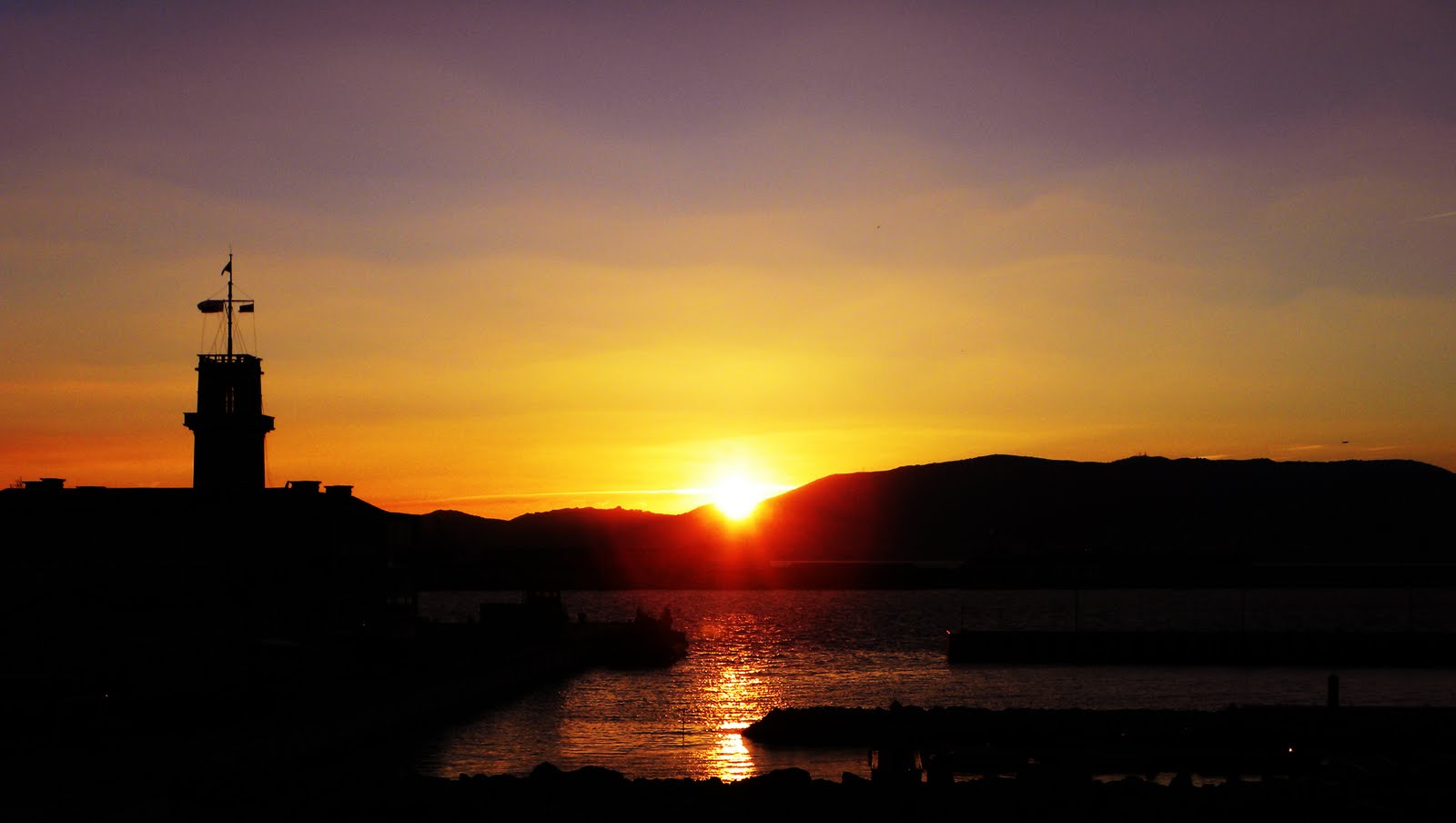
I have read that Gibraltar is a popular shopping destination as no Value Added Tax, which I have personally seen as high as 18% in Spain, is assessed. However, as I stated above, the prices on everything are in pound sterling and the exchange rate when we were there was decidedly unfavorable against both the euro and the dollar, so we did no real shopping save for attempting to locate a new battery for Sarah's camera. I also found it quite peculiar that by the time we had arrived on Main Street, nearly 17.00, most of the shoppes were either shuttered or getting ready to do so for the evening. Sadly, this included the cable car to the top of the Rock as well, although we had the option to take a guided cab tour to the peak for about 15 euros per person. Our party opted for frugality instead, figuring we'd probably miss sunset anyway which is why I had really wanted to go. I did talk the crew into waiting for me as I snapped a few shots of the sunset over Gibdock.

I would certainly say Gibraltar is worth seeing, although if you plan to go in winter you should get there early in the day; sunset is around 18.00 and the shoppes and other touristy things start evaporating around that time. Summer is probably as good a time as any to head there, although if you're looking for beaches I would venture to say that the sights on the Spanish side of the frontier are probably as good as any you'd see in Gibraltar and a bit less trouble to get to, particularly if you want to bring your beach gear in your car.

On a final note, it is my understanding from no less an authority than a Briton himself that Gibraltar is decidedly not an accurate representation of Britain itself. It has many of the looks I would expect to see in the UK but there's quite a bit of Spanish spoken there and the English sounds strange as well. (I can't speak to how the Spanish sounds as I don't understand nearly as much of the language as I would like to.) And don't feed the monkeys that inhabit the top of the Rock.

Take note: While I usually like to highlight my own photos, "Gibraltar" and "Top o the Rock" were photographed by my lovely and talented fiance. I did a bit of Photoshopping and they are now on display here for the world to see.


06 January 2011

Shameless Plug Alert!

Hello, Loyal Readers! I just wanted to take a moment to put in a shameless plug for a new blog that I have opened up: Death and Coyotes. This is where I will be posting rants on all sorts of different topics that have nothing to do with travelling.

I'm also selling my photos! You can buy the prints from my deviantArt page now! They make great Christmas gifts (remember, Christmas is only 11 shopping months away), birthday presents, anniversary gifts (I believe the sixth anniversary is known as the Photography Anniversary) and just about any other occasion you can think of. Some of the proceeds go to a good cause (me); the rest goes to DA for their associated costs, but they're hosting my stuff so I'm not complaining.

I'm going to be opening another blog soon as well, so stay tuned. I know you don't want to miss out on all the fun goodness to come!

05 January 2011

Vicissitudes

Ah, the wonders of attempting to move overseas. The different languages, the new cultures, the numerous flaming hoops through which one must jump; I doubt these will ever get old. Primarily because governments, at least the one in Spain, seem to love to randomly and arbitrarily change the rules as the prospective immigrant makes his or her way through the process. In my case, this means that when my fiance applied for her student visa there was no way for a spouse or dependent to apply with her. That is to say, had we been married before leaving for Spain, there was no visa for which I could apply that would allow me to stay in Spain with her.

All of that changed on 1 November 2010 for reasons unknown to us, the US Consular Office in Madrid and quite probably to the very government that changed these rules as answers seem to change with each office we call and each person we speak with. Immigrating to Spain is beginning to feel like trying to hit a moving target. In an earthquake. While wearing a blindfold.

As the sands continue to shift under my feet it appears that for the moment they have fixed me in a position whereby I must travel back to Miami to apply in person for a spouse-of-student visa. The Miami consular office, it seems, will not accept a proxy. So I will in all likelihood have to pack up my stuff, fly to Miami on the 17th of March, mill about the United States while a functionary ponders my fate and then travel back to Barcelona. Presuming, of course, that said functionary greets my application favorably. Needless to say, this has done nothing positive for my mood which had already been stressed by an exceedingly long back-up of my computer that kept me up until 4am.

I believe, though, now more than ever that this will all be worth it. It will certainly give me more to write about moving forward. I am attempting to sort out in my head a trip that will take me first to Miami, then Tampa, then perhaps Philadelphia to see friends and family I haven't seen in months (and hopefully a Lightning game or two!). It won't be cheap but I hope it will be valuable. I just wish it wasn't such a pain in the ass.

There are other options, no matter how limited or unpalatable they may be. Everything's still up in the air at the moment and so I am anxious to see how this all plays out over the coming months. But I'll come through this just fine, a little wiser and with a bunch of material to write about.